


Helvetica Light is an easy-to-read font, with tall and narrow letters, that works well on almost every site.
One of my favorite parts of collecting vintage NFL half-helmet plaques is that every helmet tells a story. These aren't just pieces of plastic mounted on a wall—they're time machines that instantly transport me back to a different era of football.
Through this series on Foam Finger Nation, I'll spotlight each helmet in my collection, exploring the history behind the design, the team it represented, and why it became such an iconic part of NFL culture. I'll also share what each helmet means to me personally, from the legendary players I immediately think of when I see it to the memories, games, and moments it brings rushing back.
Whether it's the powder blue of the Oilers, the silver and black of the Raiders, or the classic blue star of the Cowboys, every helmet has a story worth telling—and I can't wait to share them with fellow fans who remember when your team wasn't just a logo, it was a part of who you were.
I am always looking to add to my collection with vintage Riddell or Gresh half-helmet plaques so please reach out if you have any for sale. My collection isn't for sale but I am happy to help other collectors add to their collections as well. If you have a helmet you are looking for please feel free to contact me as well.
atlanta Falcons
1970-1975

Few helmets in NFL history are as bold and instantly recognizable as the classic Atlanta Falcons red helmet. Introduced in 1966, the bright red shell stood out in a league filled with silver, white, and darker-colored designs. Paired with the black Falcon logo and gray facemask, it gave Atlanta a look that was both fierce and unforgettable. It was a helmet that demanded attention and quickly became one of the most distinctive designs in professional football.
When I see the classic Falcons red helmet, I immediately think of Steve Bartkowski. Long before Atlanta became a regular contender, Bartkowski was the face of the franchise. The former No. 1 overall pick brought excitement and hope to Falcons fans throughout the 1970s and early 1980s, leading some of the most successful teams in franchise history. For many fans of that era, the image of Bartkowski dropping back to pass while wearing that bright red helmet is the defining visual of Falcons football.
What I love most about this helmet is its simplicity. There were no unnecessary design elements or trendy features—just a bold red shell, a clean logo, and a look that was unmistakably Atlanta. It represented a time when every NFL team had its own unique identity, and you could recognize a helmet from the other side of the stadium.
For collectors like me, the classic Falcons red helmet isn't just a piece of football history. It's a reminder of the Steve Bartkowski era, when Atlanta football was building its foundation and creating memories that still resonate with fans today.
Every helmet tells a story, and the Falcons' red helmet tells the story of a franchise finding its footing behind Steve Bartkowski and one of the most iconic helmet designs the NFL has ever seen.
Buffalo Bills
1962-1964

The classic Buffalo Bills white helmet is one of those designs that perfectly captures the spirit of the 1970s NFL. The clean white shell, paired with the charging Bills logo in red, white, and blue, created a look that was both patriotic and unmistakably Buffalo.
It was a major departure from the team's earlier red helmets and quickly became one of the most recognizable helmets in professional football.
When I see that white Bills helmet, I immediately think of Joe Ferguson. Ferguson was the face of the franchise for more than a decade and one of the toughest quarterbacks of his era. He played through injuries, took countless hits, and gave Bills fans everything he had every Sunday. While later generations may think of Jim Kelly when they picture Buffalo football, for me, the white helmet with the standing buffalo logo will always be connected to Joe Ferguson standing tall in the pocket and battling for every yard.
What I love most about this helmet is how perfectly balanced the design feels. The colorful charging buffalo pops against the white shell without being overdone. It's bold but clean, classic without feeling outdated. In an era when many teams experimented with dramatic helmet designs, Buffalo landed on something that has stood the test of time.
For collectors, this helmet represents a blue-collar franchise and a fan base known for its loyalty and passion. It reminds us of cold afternoons at Rich Stadium, hard-nosed AFC football, and a quarterback who embodied the toughness of Western New York.
Every helmet tells a story, and the Buffalo Bills' white helmet tells the story of grit, perseverance, and Joe Ferguson leading the charge for a franchise and fan base that never stopped believing.
Chicago Bears
1973-Current

The Chicago Bears' modern navy helmet with the orange wishbone "C" may still be worn today, but for me it will always belong to the 1985 Bears. Few teams in NFL history have ever captured the imagination of football fans quite like that group.
They weren't just champions—they were larger-than-life personalities who dominated the league with a swagger and confidence that made them unforgettable.
When I see this helmet, I immediately think of the stars of that legendary team: Walter Payton, Mike Singletary, Richard Dent, and Jim McMahon. Every one of them seemed larger than life. Whether it was Payton's brilliance, Singletary's intensity, Dent's dominance, or McMahon's rebellious attitude, they combined to create one of the most memorable teams sports has ever seen.
What I love most about this helmet is how much history it carries. The design itself is simple—a navy shell, orange "C," and gray facemask—but the memories attached to it make it iconic. The moment I see it, I think of the "Super Bowl Shuffle," Buddy Ryan's ferocious defense, and a team that looked like it was having as much fun as it was winning.
For collectors, this helmet isn't just a piece of Bears history. It's a symbol of one of the greatest single-season teams ever assembled. Even fans who weren't rooting for Chicago can appreciate what that 1985 team accomplished and the mark they left on the NFL.
Every helmet tells a story, and the Chicago Bears' navy helmet tells the story of the 1985 Monsters of the Midway—a team so dominant and memorable that nearly four decades later, they're still the standard by which great NFL teams are measured.
Cincinnati Bengals
1981-Present

The Cincinnati Bengals' tiger-striped helmet is one of the most revolutionary designs in NFL history. When it debuted in 1981, it broke all the rules. Instead of placing a logo on the side of the helmet, the helmet itself became the logo. The orange-and-black tiger stripes instantly gave the Bengals one of the most recognizable identities in sports and remains one of the greatest helmet designs ever created.
When I see the striped Bengals helmet, I don't think of just one player—I think of an entire era. I think of Boomer Esiason leading one of the most explosive offenses in football. I think of Ickey Woods high-stepping his way into the end zone before breaking out the legendary Ickey Shuffle. And I think of Cris Collinsworth stretching defenses and making big plays downfield. Together, they helped define Bengals football during one of the most exciting periods in franchise history.
What I love most about this helmet is that it looks just as bold today as it did more than four decades ago. Most helmet designs eventually need a refresh, but the Bengals got it right the first time. The tiger stripes are aggressive, distinctive, and instantly recognizable from anywhere in the stadium.
For collectors, this helmet represents much more than a clever design. It brings back memories of the Bengals' Super Bowl run, the electric atmosphere of Riverfront Stadium, and one of the most entertaining offenses of the late 1980s. It reminds us of a time when Boomer was slinging passes, Collinsworth was making defenses pay, and Ickey Woods had the entire country doing the Shuffle.
Every helmet tells a story, and the Bengals' tiger-striped helmet tells the story of one of football's most innovative designs and the unforgettable trio of Boomer Esiason, Cris Collinsworth, and Ickey Woods who helped make it legendary.
Dallas Cowboys

The Dallas Cowboys' silver helmet isn't just one of the most iconic helmets in NFL history—it's one of the most recognizable symbols in all of sports. The metallic silver shell, blue star, and blue-and-white striping create a look that has remained virtually unchanged for decades because there was never any reason to improve upon perfection. Whether you loved the Cowboys or loved to hate them, that helmet commanded attention every time it took the field.
When I see the classic Cowboys helmet, I don't think of one player. I think of an entire constellation of stars. I think of Roger Staubach scrambling away from pressure and delivering another miracle comeback. I think of Danny White carrying the franchise into the next era. I think of Tony Dorsett turning a simple handoff into an electrifying touchdown. I think of Drew Pearson making impossible catches, Doug Cosbie moving the chains, and defensive legends like Randy White and Ed Jones dominating opponents on the other side of the ball.
What I love most about this helmet is that it represents excellence across multiple generations. The players changed, the eras changed, and the game changed, but the star remained. For decades, some of the greatest players in football history ran onto the field wearing that silver helmet, creating memories that still resonate with fans today.
For collectors, the Cowboys helmet is more than a piece of memorabilia—it's a time machine. One glance can transport you to Thanksgiving Day games, Monday Night Football battles, and championship runs that helped make Dallas "America's Team." The helmet carries the weight of countless Hall of Famers, unforgettable moments, and a standard of excellence that few franchises have ever matched.
Every helmet tells a story, and the Dallas Cowboys' silver helmet tells the story of football royalty—a helmet worn by Roger Staubach, Tony Dorsett, Drew Pearson, Randy White, Too Tall Jones, Danny White, Doug Cosbie, and so many other stars who helped build one of the greatest franchises in sports history.
Denver Broncos
1968-1996

The Denver Broncos' classic blue helmet with the orange-and-white "D" logo is one of the defining looks of 1970s and 1980s football. Before the modern horse-head logo and navy uniforms, the Broncos took the field in a bright blue helmet that practically screamed old-school NFL. The bold orange "D" with the kicking white horse inside wasn't just a logo—it was a symbol of a franchise that was about to enter its greatest era.
When I see that helmet, there is only one player who comes to mind: John Elway. I know Elway spent part of his career wearing the newer Broncos helmet, but in my mind, he'll always be connected to the blue helmet with the orange "D." I think of "The Drive" against Cleveland, the impossible comebacks, the cannon arm, and the relentless competitiveness that made him one of the greatest quarterbacks to ever play the game. Elway didn't just play for the Broncos—he was the Broncos for an entire generation of fans.
What I love most about this helmet is that it feels uniquely tied to a specific era of football. The bright blue shell, orange logo, and gray facemask instantly transport me back to AFC Championship games, Mile High Stadium, and those Broncos teams that always seemed to find a way to win. It has a charm and character that many modern helmet designs simply can't replicate.
For collectors, this helmet represents one of the NFL's great quarterback-franchise partnerships. It reminds us of packed stadiums, snowy Denver afternoons, and a player who carried the hopes of an entire city on his shoulders for nearly two decades. Even today, it's impossible to look at that orange "D" without thinking of number 7 standing in the pocket, scanning the field, and getting ready to make another unforgettable play.
Every helmet tells a story, and the Broncos' blue helmet with the orange "D" tells the story of John Elway—a quarterback whose toughness, talent, and determination helped transform Denver into one of the NFL's premier franchises.
Houston Oilers
1966-1971

The Houston Oilers' silver helmet doesn't get nearly as much attention as the famous powder blue version, but it deserves its place in NFL history. Worn during the franchise's early years, the silver shell featured the iconic red derrick logo that would become synonymous with Houston football. It was a clean, straightforward design that reflected the rugged, hardworking identity of a city built on the oil industry.
Unlike the powder blue helmet, which immediately grabs your attention, the silver Oilers helmet has a more understated quality. It feels like a piece of football history from a different era—before elaborate uniform combinations, before alternate helmets, and before teams constantly reinvented their look. It's a reminder of a time when a simple logo and a strong identity were all a team needed.
When I look at this helmet, I don't necessarily think of one specific player. Instead, I think about the origins of the franchise and the foundation that was built before the Oilers became known for their iconic powder blue uniforms. The silver helmet represents the early chapters of Houston professional football and the AFL roots that helped shape the modern game.
What I love most about it is that it tells a different story than the powder blue helmet. While the powder blue version became legendary, the silver helmet feels like a hidden gem—something that true football historians and collectors appreciate. It's a reminder that every iconic franchise had a beginning, and this helmet was part of the Oilers' first steps toward becoming one of the most recognizable teams of their era.
For collectors, the silver Oilers helmet is a piece of forgotten football history. It may not be the helmet most fans immediately associate with Houston, but that's exactly what makes it special. It represents the franchise before it became famous, before the powder blue became iconic, and before generations of fans fell in love with one of the NFL's most distinctive identities.
Every helmet tells a story, and the Houston Oilers' silver helmet tells the story of beginnings—the early days of a franchise that would eventually create one of the most beloved looks in all of professional football.
Houston Oilers
1975-1996

The Houston Oilers' white helmet may not get the same attention as the powder blue version, but when I see it, I see the entire history of Houston football wrapped into one unforgettable image. The crisp white shell, accented by the iconic red derrick logo and Oilers colors, stood out under the lights of the Astrodome and became part of some of the most memorable moments in franchise history. It's a helmet that instantly transports me back to a different era of football.
When I look at this helmet, I don't think of just one player—I think of a parade of Oilers legends. I think of Earl Campbell running through defenders as if they were standing still. I think of Dan Pastorini leading the Luv Ya Blue teams of the late 1970s. I think of Billy Johnson electrifying crowds every time he touched the football. I think of Warren Moon orchestrating the high-powered Run and Shoot offense that made Houston one of the most exciting teams in football.
But the Oilers were about more than just great players. I think of Bum Phillips in his cowboy hat, building a team that perfectly reflected the spirit of Texas. I think of the Astrodome itself, the "Eighth Wonder of the World," where generations of Houston fans gathered to cheer for their team and create memories that still live on today.
What I love most about this helmet is that it represents so many different eras. The hard-nosed toughness of Earl Campbell. The swagger of White Shoes. The grit of Pastorini. The aerial fireworks of Warren Moon and the Run and Shoot. Few helmets can connect so many iconic moments and personalities across multiple decades.
For collectors, this helmet isn't just a piece of football memorabilia—it's a piece of Houston history. It represents Luv Ya Blue, packed crowds in the Astrodome, and a franchise that left an imprint on the city that remains strong to this day.
Every helmet tells a story, and the Houston Oilers' white helmet tells the story of Houston football at its best—from Earl Campbell's punishing runs and Dan Pastorini's toughness to White Shoes' celebrations, Warren Moon's Run and Shoot magic, Bum Phillips' leadership, and unforgettable Sundays inside the Astrodome.
Los Angeles Rams
1964-1972

The Los Angeles Rams' classic white horn helmet is one of the most beautiful and influential designs in football history. Long before modern teams obsessed over alternate uniforms and helmet combinations, the Rams created something truly iconic. The bright blue horns wrapping around the white shell made the helmet instantly recognizable and helped establish the idea that a helmet could be more than just equipment—it could be art.
When I see the white Rams helmet, I immediately think of Roman Gabriel. Even as a kid, I always thought that was one of the coolest names in football. Roman Gabriel sounded tough enough to be an NFL quarterback but also had a movie-star quality to it, like someone who could just as easily be starring in a Hollywood blockbuster as leading a football team. It was the perfect name for a quarterback playing in Los Angeles.
Gabriel was the face of the Rams throughout the 1960s and early 1970s, earning NFL MVP honors and helping transform the franchise into a consistent contender. He had the size, the arm, and the presence to command the field, and when I picture him, I picture him standing under center wearing that legendary white helmet with the blue horns curling around the sides.
What I love most about this helmet is its elegance. The design is bold without being complicated. The horns aren't just a logo placed on the helmet—they are the helmet. Decades later, countless teams have tried to create something as distinctive, but very few have succeeded.
For collectors, the Rams' white horn helmet represents the golden age of Los Angeles football. It brings back memories of the Coliseum, sun-soaked Sunday afternoons, and a time when the Rams were one of the NFL's glamour franchises. More than anything, it reminds me of Roman Gabriel—a quarterback with one of the toughest and coolest names the game has ever known.
Every helmet tells a story, and the Los Angeles Rams' white horn helmet tells the story of style, tradition, and Roman Gabriel—a name that sounded every bit as legendary as the football he played.
Miami Dolphins
1973-1979

The Miami Dolphins' classic helmet is pure football nostalgia. The aqua shell, orange sunburst, and leaping dolphin created one of the most colorful and recognizable designs in sports. It perfectly captured the feel of South Florida—sunshine, speed, and excitement. Even today, few helmets can match the instant visual impact of those classic Dolphins uniforms running onto the field.
When I see the Dolphins helmet, the first player who comes to mind is Dan Marino. Marino's lightning-quick release, rocket arm, and ability to dissect defenses made him one of the greatest quarterbacks to ever play the game. Every Sunday seemed to bring another impossible throw, another comeback, or another reminder that you were watching someone special.
But Marino wasn't doing it alone. I also think of the "Marks Brothers"—Mark Duper and Mark Clayton. Together, they formed one of the most dangerous receiving duos in NFL history. Defenses knew the ball was going to Duper or Clayton, and it often didn't matter. Marino would find them anyway. Their speed, chemistry, and big-play ability helped define one of the most explosive passing attacks football had ever seen.
What I love most about this helmet is how closely it's tied to that era of Dolphins football. The moment I see it, I'm transported back to the Orange Bowl, watching Marino drop back in the pocket while Duper and Clayton streak downfield. It was football at its most exciting—an offense that could score from anywhere on the field at any moment.
For collectors, the Dolphins helmet represents one of the NFL's most entertaining teams and one of the greatest quarterback-receiver combinations the game has ever seen. It's a reminder of a time when Miami's offense was must-see television and every snap carried the possibility of something spectacular.
Every helmet tells a story, and the Miami Dolphins' classic helmet tells the story of Dan Marino and the Marks Brothers—an unforgettable trio that turned the passing game into an art form and made Sundays in Miami electric.
New England Patriots
1964-1992

The New England Patriots' classic white helmet with the Pat Patriot logo is one of the most beloved and nostalgic designs in NFL history. Before the Flying Elvis logo and modern uniforms, the Patriots took the field wearing a bright white helmet featuring the iconic Revolutionary War minuteman preparing to snap the football. It was a design full of character and personality, and for many fans, it remains the definitive Patriots helmet.
When I see that helmet, I immediately think of Steve Grogan. Grogan embodied toughness. He played through injuries, ran when he had to, and gave Patriots fans everything he had for 16 seasons. He was the heart and soul of New England football during an era when success was earned the hard way.
I also think of Mosi Tatupu, a fan favorite whose hard-nosed style perfectly fit the Patriots' identity, along with Tony Collins, one of the most dynamic offensive weapons of the early 1980s. And of course, I think of Irving Fryar, the first overall pick in the 1984 NFL Draft, whose speed and playmaking ability gave Patriots fans plenty to cheer about.
On the defensive side, it's impossible not to think of Kenneth Sims. The former number-one overall pick brought talent and intensity to a defense that helped New England reach Super Bowl XX. And while he didn't spend his entire career in New England, I also remember Vagas Ferguson, whose tough running style made him a valuable part of the Patriots' offense during the 1980s.
What I love most about this helmet is how much personality it had. The Pat Patriot logo wasn't sleek or modern—it was fun, uniquely American, and instantly recognizable. It stood out in a league filled with simple decals and remains one of the greatest helmet logos ever created.
For collectors, this helmet represents a different era of Patriots football, long before dynasties and Super Bowl rings became expected. It brings back memories of cold afternoons in Foxboro, Steve Grogan's grit, Irving Fryar's big plays, Kenneth Sims' defensive presence, and the colorful Pat Patriot logo standing proudly on the side of one of football's most memorable helmets.
Every helmet tells a story, and the Patriots' white helmet tells the story of Steve Grogan, Vagas Ferguson, Kenneth Sims, Irving Fryar, and an era when New England football was built on toughness, determination, and one of the most iconic logos the NFL has ever seen.
New York Giants
1976-1999

The New York Giants' helmet with "GIANTS" spelled out on the side is one of the most iconic helmets of the 1980s. While the franchise would later return to the lowercase "ny" logo, for many football fans, this is the Giants helmet they remember best. The deep blue shell, bold red-and-white striping, and simple "GIANTS" wordmark perfectly captured the blue-collar toughness that defined New York football during one of the franchise's greatest eras.
When I see that helmet, I immediately think of the legendary teams that brought championships back to New York. I think of Phil Simms standing in the pocket and delivering one of the greatest Super Bowl performances ever. I think of Joe Morris grinding out tough yards and becoming the engine of the offense. I think of Mark Bavaro refusing to be tackled and embodying everything that Giants football stood for. And I think of Phil McConkey making clutch plays on the biggest stage.
But as great as the offense was, this helmet will always be associated with defense. I think of Lawrence Taylor, arguably the most dominant defensive player the game has ever seen. Every time Taylor lined up, offenses had to know where he was. Alongside him was Harry Carson, the steady leader and future Hall of Famer who anchored one of the greatest defenses in NFL history.
What I love most about this helmet is that it represents a team with a clear identity. The Giants weren't flashy. They were physical, disciplined, and tough. The helmet itself reflects that attitude—simple, straightforward, and built for business.
For collectors, this helmet brings back memories of Bill Parcells on the sideline, cold afternoons at Giants Stadium, and championship football. It represents a golden era when the Giants combined toughness, talent, and personality to become one of the NFL's premier franchises.
Every helmet tells a story, and the Giants' wordmark helmet tells the story of Phil Simms, Joe Morris, Mark Bavaro, Phil McConkey, Harry Carson, and the incomparable Lawrence Taylor—a group of players who helped build one of the toughest and most memorable teams football has ever seen.
New York Jets
1978-1989

The New York Jets' green helmet is pure 1980s football to me. The rich green shell, white facemask, and bold "JETS" logo created a look that felt tough, confident, and unmistakably New York. While the white helmet will always be associated with Joe Namath and Super Bowl III, the green helmet represents a different era—one filled with big personalities, exciting quarterbacks, and one of the most feared defensive lines in NFL history.
When I see the green Jets helmet, I immediately think of Richard Todd and Ken O'Brien. Todd helped usher the Jets into the 1980s and led some memorable playoff runs, while O'Brien quietly became one of the most underrated quarterbacks of his generation. In an era dominated by Dan Marino, John Elway, and Joe Montana, O'Brien often doesn't get the recognition he deserves, but Jets fans know how good he really was.
On the defensive side, this helmet will forever remind me of the New York Sack Exchange. I think of Joe Klecko, one of the toughest and most versatile defensive players to ever wear a Jets uniform. I think of Mark Gastineau, whose speed off the edge and larger-than-life personality made him one of the most recognizable stars of the decade. Together, they helped make the Jets defense one of the most exciting units in football.
What I love most about this helmet is how perfectly it reflects the era. It takes me back to Shea Stadium, muddy fields, cold AFC East battles, and a time when the Jets always seemed to have larger-than-life characters wearing green and white. The helmet itself isn't complicated, but it carries the memories of some unforgettable players.
For collectors, the Jets' green helmet represents a unique chapter in franchise history. It may not have a Super Bowl attached to it, but it has plenty of personality. It reminds us of Ken O'Brien's precision, Richard Todd's toughness, Joe Klecko's dominance, and Mark Gastineau's relentless pursuit of quarterbacks.
Every helmet tells a story, and the New York Jets' green helmet tells the story of the 1980s Jets—an era defined by Ken O'Brien, Richard Todd, Joe Klecko, Mark Gastineau, and a team that always seemed larger than life.
Philadelphia Eagles
1969-1973 (Away Games)

The Philadelphia Eagles' white helmet is one of those fascinating pieces of NFL history that feels almost forgotten today. Long before the Kelly green helmets with silver wings became iconic, the Eagles spent portions of their early history wearing white helmets that looked completely different from the designs most fans associate with the franchise today. It's a helmet that immediately catches your attention because it simply doesn't look like the Eagles we know.
What's interesting about this helmet is that, unlike many others in my collection, I don't immediately connect it to a specific player. I couldn't tell you who wore it without looking it up, and that's actually part of what makes it special to me. Instead of thinking about a particular quarterback, running back, or Hall of Famer, I find myself thinking about the history of the game itself and how much football has changed over the decades.
The white Eagles helmet represents an era when professional football was still finding its identity. Uniforms were simpler, television coverage was limited, and many of the players who wore these helmets have faded from the memories of all but the most dedicated football historians. Yet every franchise has those early chapters, and this helmet serves as a reminder that the Eagles' story didn't begin with the players we remember most.
What I love most about this helmet is that it sparks curiosity. Every time I look at it, I find myself wondering about the players who wore it, the stadiums they played in, and what football Sundays were like during that era. It feels less like a piece of memorabilia and more like a time capsule from another generation.
For collectors, the white Eagles helmet is a reminder that not every great helmet is tied to a famous player or a championship season. Sometimes the appeal comes from the mystery itself. It represents the roots of a proud franchise and a period of football history that deserves to be remembered.
Every helmet tells a story, and the Philadelphia Eagles' white helmet tells a story that many fans—including me—are still discovering. Sometimes the most interesting helmets are the ones that leave you with more questions than answers.
Pittsburgh Steelers

The Pittsburgh Steelers' black helmet is one of the most iconic helmets in the history of sports. The gold stripe, the simple black shell, and the unique decision to place the Steelers logo on only one side of the helmet created a look unlike anything else in professional football. It doesn't need flashy colors or complicated graphics. The helmet's power comes from what it represents: championships, toughness, and one of the greatest dynasties the NFL has ever seen.
When I see that helmet, I immediately think of an entire generation of legends. I think of Terry Bradshaw launching deep passes and leading the Steelers to four Super Bowl titles. I think of Franco Harris powering through defenses and delivering one of the most famous plays in football history. I think of Lynn Swann making acrobatic catches that seemed impossible and John Stallworth quietly becoming one of the most dependable receivers of his era.
But what truly made those Steelers teams special was the defense. I think of Jack Lambert, toothless, intimidating, and seemingly born to wear black and gold. I think of Jack Ham, whose intelligence and athleticism made him one of the greatest linebackers the game has ever seen. And I think of Joe Greene, the heart and soul of the Steel Curtain defense, whose toughness helped define an entire era of football.
What I love most about the Steelers helmet is that it feels larger than the players themselves. The moment you see it, you think of championships, cold afternoons at Three Rivers Stadium, and a franchise that expected excellence every time it took the field. The helmet carries a sense of history that very few teams can match.
For collectors, the Steelers helmet represents football greatness at its highest level. It evokes memories of the Steel Curtain, Super Bowl victories, and a roster packed with Hall of Famers. Every scratch, every scuff, and every image of that black helmet tells a story about one of the greatest teams ever assembled.
Every helmet tells a story, and the Pittsburgh Steelers' black helmet tells the story of Terry Bradshaw, Franco Harris, Lynn Swann, John Stallworth, Jack Lambert, Jack Ham, Mean Joe Greene, and a dynasty that set the standard for greatness in professional football.
San Diego Chargers
1961-1965

The San Diego Chargers' white helmet with the player number on the side is one of the most unique and beautiful helmet designs in football history. While most teams relied solely on a logo, the Chargers combined their iconic lightning bolt with player numbers, creating a look that was instantly recognizable. The bright white shell, gold-and-blue bolt, and bold numbers gave the helmet a distinctly AFL feel and helped make the Chargers one of the sharpest-looking teams of the 1960s.
When I see this helmet, I immediately think of Lance Alworth. "Bambi" wasn't just one of the greatest Chargers players of all time—he was one of the first true superstar wide receivers in professional football. His speed, grace, and big-play ability helped define the AFL and made him must-watch television long before that phrase existed. When I picture Alworth streaking downfield, I picture him beneath that iconic numbered white helmet.
What I love most about this helmet is that it represents a time when football wasn't afraid to be different. The numbers on the helmet gave it a personality all its own and helped separate the Chargers from every other team in the league.
Every helmet tells a story, and the Chargers' numbered white helmet tells the story of Lance Alworth, the AFL, and one of the most distinctive helmet designs professional football has ever seen.
San Francisco 49ers
1964-1988

The San Francisco 49ers' gold helmet is one of the most iconic symbols in football history. The gleaming gold shell, bold red stripe, and interlocking "SF" logo became the standard for excellence throughout the 1980s and beyond. Even as a Cowboys fan, it's impossible not to respect what that helmet represents. When the 49ers took the field wearing gold and red, you knew you were about to watch one of the NFL's premier franchises.
When I see the 49ers helmet, the first name that comes to mind is Joe Montana. Cool, calm, and seemingly impossible to rattle, Montana made some of the biggest moments in football history look routine. Of course, no Cowboys fan can see that helmet without thinking of Dwight Clark and "The Catch." It's one of those plays that is forever burned into NFL history. As a Cowboys fan, I wish it had turned out differently, but as a football fan, I can appreciate just how legendary that moment became.
I also think of Roger Craig, one of the most complete running backs of his era. Craig could run, catch, block, and do just about everything an offense needed. And then there's Jerry Rice. Simply put, the greatest wide receiver who ever lived. His work ethic, precision, and production set a standard that may never be matched.
What I love most about this helmet is that it represents sustained greatness. So many franchises have had a great season or even a great run. The 49ers built a dynasty. Every time I see that gold helmet, I think about championship games, Super Bowls, and a roster filled with Hall of Famers.
For collectors, the 49ers helmet represents one of the NFL's golden ages. It brings back memories of Montana leading a game-winning drive, Dwight Clark reaching for the football, Roger Craig doing a little bit of everything, and Jerry Rice making the impossible look ordinary.
Every helmet tells a story, and the San Francisco 49ers' gold helmet tells the story of Joe Montana, Dwight Clark, Roger Craig, Jerry Rice, and a dynasty that even a Cowboys fan has to admire—though I'll never fully forgive them for The Catch.
St. Louis Cardinals
1960-1987

The St. Louis Cardinals' white helmet is a reminder of a franchise that often gets overlooked in NFL history. The bright white shell, cardinal-red bird logo, and clean striping gave the team a distinctive look that stood out from the crowd. Long before the Cardinals moved to Arizona, this helmet was a familiar sight on Sundays in St. Louis and represented an era of football that deserves to be remembered.
When I see the Cardinals helmet, I immediately think of Jim Hart. Hart was the face of the franchise for nearly two decades and one of the most productive quarterbacks of his generation. He seemed to be under center forever, leading the Cardinals through some of their most successful seasons and becoming one of the most respected players in team history.
I also think of Ottis Anderson, better known to many fans as O.J. Anderson. Before his Super Bowl heroics with the Giants, Anderson was a star in St. Louis, combining power, balance, and durability to become one of the NFL's most reliable running backs. He gave Cardinals fans a reason to believe every time he touched the football.
What I love most about this helmet is that it represents one of the NFL's forgotten teams. The Cardinals didn't receive the national attention of franchises like Dallas, Pittsburgh, or San Francisco, but they had outstanding players, loyal fans, and a unique identity all their own. The white helmet with the cardinal logo feels like a hidden gem from another era of football.
For collectors, the St. Louis Cardinals helmet evokes memories of Busch Memorial Stadium, Jim Hart dropping back to pass, and Ottis Anderson carrying defenders for extra yards. It's a piece of NFL history that deserves more appreciation than it often receives.
Every helmet tells a story, and the St. Louis Cardinals' white helmet tells the story of Jim Hart, Ottis "O.J." Anderson, and a proud franchise that may be gone from St. Louis but still holds an important place in football history.
Tampa Bay Buccaneers
1976-1991

The Tampa Bay Buccaneers' original "Creamsicle" helmet is one of the most beloved and recognizable helmets in NFL history. The bright orange shell, red facemask, and swashbuckling Bucco Bruce logo were unlike anything else in professional football. It was colorful, fun, and completely unique—a perfect reflection of a young franchise trying to carve out its place in the league.
When I see that helmet, I immediately think of Doug Williams and Lee Roy Selmon. Williams was the first great quarterback in franchise history, leading Tampa Bay from expansion struggles to the NFC Championship Game in just a few short years. His leadership and poise helped make the Buccaneers relevant far sooner than anyone expected.
On the other side of the ball was Lee Roy Selmon, the cornerstone of the franchise and still one of the most respected players to ever wear a Buccaneers uniform. Selmon combined talent, toughness, and class in a way that made him the perfect face of the organization. If you were building the Tampa Bay Buccaneers from scratch, Lee Roy Selmon is exactly the kind of player you'd want to start with.
What I love most about this helmet is that it represents one of the greatest turnarounds in NFL history. After losing their first 26 games as a franchise, the Buccaneers quickly became contenders behind players like Williams and Selmon. The orange helmet went from being associated with an expansion team to being associated with winning football.
For collectors, the Creamsicle helmet brings back memories of old Tampa Stadium, warm Florida afternoons, and a franchise that found its identity through grit and perseverance. It reminds us of Doug Williams throwing passes, Lee Roy Selmon dominating offensive linemen, and one of the most distinctive uniforms ever to take the field.
Every helmet tells a story, and the Tampa Bay Buccaneers' Creamsicle helmet tells the story of Doug Williams, Lee Roy Selmon, and a young franchise that overcame humble beginnings to earn its place in NFL history.
Baltimore Colts

The classic Baltimore Colts helmet is a perfect example of how simplicity can create something timeless. The bright white shell, accented by the iconic blue horseshoe on each side, became one of the most recognizable looks in professional football.
There were no flashy graphics or complicated designs—just a clean, confident helmet that represented a franchise known for toughness, tradition, and excellence.
When I see the Baltimore Colts helmet, I immediately think of Bert Jones. Nicknamed "The Ruston Rifle," Jones possessed one of the strongest arms the game had ever seen and was the centerpiece of the Colts during the 1970s. Before injuries cut his career short, he was widely considered one of the NFL's elite quarterbacks, earning NFL MVP honors in 1976 and leading Baltimore through one of the franchise's most exciting eras. For me, it's impossible to separate Bert Jones from that iconic white helmet with the blue horseshoe.
What I love most about the Colts helmet is its understated confidence. It didn't need bright colors or dramatic logos to stand out. The horseshoe symbolized luck, tradition, and hard-nosed football, and it became one of the most respected marks in the NFL. Decades later, it remains virtually unchanged because great designs don't need reinvention.
For collectors, the Baltimore Colts helmet represents more than just a team. It represents a lost era of NFL football, a franchise that once called Baltimore home, and one of the most talented quarterbacks of his generation. Every time I look at it, I think of Bert Jones firing passes downfield and reminding the league that greatness often comes in the simplest package.
Every helmet tells a story, and the Baltimore Colts helmet tells the story of tradition, toughness, and the powerful right arm of Bert Jones.
Chicago Bears
1962-1972

The classic Chicago Bears helmet with the white wishbone-style "C" logo is one of the most historic looks in NFL history. Navy blue, simple, and unmistakably Chicago, it represents an era when football was played with a little less flash and a lot more toughness. Unlike today's polished uniforms and helmet designs, this helmet feels like it belongs to a different time—a time of frozen fields, muddy uniforms, and hard-nosed football.
When I look at this helmet, I immediately think of Dick Butkus. The truth is, I never saw Butkus play live. I've only seen him through old game film, NFL highlights, and stories passed down through generations of football fans. Yet somehow, that's enough. Every clip seems to confirm the legend. He played with a level of intensity that is almost impossible to imagine in today's game. The helmet and the player have become inseparable in my mind.
What I love most about this Bears helmet is that it doesn't need anything fancy. The white logo, gray facemask, and dark navy shell reflect exactly what the franchise has always been about: tradition, toughness, and defense. It's a helmet that looks like it belongs in black-and-white photographs just as much as it does in color.
For collectors, this helmet represents more than just a football team. It represents an era that many of us know only through stories and film reels. Every time I see it, I think about sitting down to watch old NFL footage and being reminded that some players become legends not because we witnessed them firsthand, but because their greatness transcends generations.
Every helmet tells a story, and this Chicago Bears helmet tells the story of football's rugged past, where legends like Dick Butkus still leave an impression on fans who never had the chance to see them play in person.
Cincinnati Bengals
1969-1979

The original Cincinnati Bengals helmet with "BENGALS" spelled out on the side is one of the most unique helmets in NFL history. Before the famous tiger stripes arrived in 1981, Cincinnati's helmet relied on something much simpler: an orange shell, a clean black facemask, and the team name boldly displayed on each side. It was unconventional, unmistakable, and perfectly reflected a young franchise establishing its identity in the AFL and early NFL years.
When I see that helmet, I immediately think of Ken Anderson. Long before the Bengals became known for striped helmets and modern stars, Anderson was quietly becoming one of the most efficient and underrated quarterbacks the game has ever seen. The 1981 NFL MVP led Cincinnati to its first Super Bowl appearance and spent his entire career representing everything you would want in a franchise quarterback. For me, no player is more closely tied to the "BENGALS" helmet than Ken Anderson.
What I love most about this helmet is its simplicity and originality. In an era filled with logos and symbols, Cincinnati boldly put its name front and center. There was no mistaking who they were. It may not have had the visual flair of the tiger-striped helmet that followed, but it had a personality all its own and remains one of the most distinctive designs of the 1970s.
For collectors, this helmet represents a forgotten chapter of Bengals history. While most fans immediately think of the striped design, the wordmark helmet tells the story of the franchise's formative years and one of the greatest quarterbacks to ever wear a Bengals uniform. It's a reminder that before the stripes became iconic, Cincinnati had already built a proud football tradition.
Every helmet tells a story, and the Bengals' original wordmark helmet tells the story of a young franchise finding its footing behind the steady leadership and remarkable talent of Ken Anderson.
Cleveland Browns
1975-1995

The classic Cleveland Browns helmet proves that sometimes the simplest designs are the most iconic. With its plain orange shell, brown-and-white striping, and no logo whatsoever, it stands apart from every other helmet in professional football. It doesn't rely on a mascot or a symbol to tell you who it is. The helmet's identity comes from its tradition, its history, and the generations of players who wore it.
When I see the Browns' classic helmet, I immediately think of some of the players who defined Cleveland football for me. I think of Brian Sipe, the 1980 NFL MVP who led the beloved "Kardiac Kids." I think of Ozzie Newsome making impossible catches and becoming one of the greatest tight ends the game has ever seen. I think of Ernest Byner grinding out tough yards and helping power some of Cleveland's best teams. And I think of Webster Slaughter stretching defenses and providing big-play excitement during the late 1980s.
What I love most about this helmet is its confidence. Most teams spend decades tweaking logos and redesigning uniforms, but the Browns have largely stayed true to a look that has endured for generations. The orange helmet doesn't need a logo because the helmet itself is the logo. It's one of the few designs in sports that can be identified instantly from across the room.
For collectors, the Browns helmet represents old-school football at its finest. It brings back memories of Municipal Stadium, freezing Sundays on the shores of Lake Erie, and teams that reflected the toughness and resilience of the city they represented. Every scratch and scuff on an old Browns helmet feels like part of its story.
Every helmet tells a story, and the Cleveland Browns' classic orange helmet tells the story of grit, tradition, and the players who made Browns football unforgettable—from Brian Sipe and Ozzie Newsome to Ernest Byner and Webster Slaughter.
Detroit Lions

The Detroit Lions' classic silver helmet is one of the NFL's most underrated designs. The bright Honolulu Blue striping and leaping lion logo perfectly complement the silver shell, creating a look that is both elegant and unmistakably Detroit. It may not get the same attention as some of the league's flashier helmets, but it has quietly stood the test of time and remains one of football's true classics.
When I see the Lions helmet, I think of a collection of players who made Sundays in Detroit memorable. I think of Eric Hipple leading the offense during the early 1980s and becoming one of the most beloved players of his era. I think of Billy Sims electrifying defenses with his speed and explosiveness before injuries cut his career short. I think of Barry Sanders doing things on a football field that still seem impossible decades later. I think of Herman Moore making big catches all over the field and Chris Spielman bringing toughness and intensity to every snap.
What I love most about this helmet is how many different eras it represents. From Billy Sims dazzling defenders, to Eric Hipple's grit, to the dominance of Barry Sanders and Herman Moore, and the relentless effort of Chris Spielman, the helmet serves as a bridge connecting generations of Lions football.
For collectors, the Lions helmet evokes memories of Thanksgiving Day games, packed crowds at the Silverdome, and some of the most exciting players ever to wear an NFL uniform. More than anything, it reminds me of Barry Sanders effortlessly making defenders miss while wearing one of the cleanest uniforms in professional sports.
Every helmet tells a story, and the Detroit Lions' silver helmet tells the story of unforgettable talent—from Eric Hipple and Billy Sims to Chris Spielman, Herman Moore, and the incomparable Barry Sanders, whose highlights continue to define greatness for football fans everywhere.
Green Bay Packers

The Green Bay Packers' helmet is one of the rare designs in sports that has become completely timeless. The green shell and iconic white "G" logo have remained largely unchanged for generations, proving that great designs don't need to be reinvented. For decades, that helmet has represented tradition, excellence, and a standard of winning that few franchises in any sport can match.
What makes the Packers helmet special to me is that it isn't tied to just one era or one player. When I see it, I don't think of a single moment in time—I think of the entire history of the franchise. I think of Vince Lombardi pacing the sidelines and building one of the greatest dynasties football has ever known. I think of Bart Starr leading championship teams and sneaking into the end zone in the Ice Bowl. I think of Brett Favre playing with unmatched passion and toughness, and I think of Aaron Rodgers making impossible throws look routine.
What I love most about this helmet is its ability to connect generations of football fans. Few teams can point to a direct line from Lombardi and Starr to Favre and Rodgers and still be represented by essentially the same helmet. The logo, the colors, and the identity have remained remarkably consistent while the legends wearing it continued to change.
For collectors, the Packers helmet is more than a piece of memorabilia. It's a symbol of football history itself. It represents championships, frozen tundra, small-town pride, and some of the greatest players and coaches the game has ever seen. Whether you grew up watching black-and-white footage of Lombardi's teams or Sunday afternoons with Favre and Rodgers, that helmet means something.
Every helmet tells a story, and the Green Bay Packers helmet tells one of the greatest stories in sports—a story that stretches from Vince Lombardi and Bart Starr to Brett Favre and Aaron Rodgers, linking generations through a tradition of excellence that has endured for more than half a century.
Houston Oilers
1972-1974

The Houston Oilers' powder blue helmet is, in my opinion, one of the most beautiful helmets ever created. The combination of the light blue shell, the simple white derrick logo, and the clean red-and-white accents created a look that was uniquely Houston and unlike anything else in professional football. Even decades after the Oilers left Houston, that helmet remains one of the most beloved and recognizable designs in NFL history.
What's interesting about this helmet is that, unlike many others in my collection, it isn't tied to one specific player in my mind. Sure, you could think of great Oilers like Earl Campbell, Warren Moon, or Dan Pastorini, but when I look at this helmet, I don't immediately picture any one of them. Instead, I think about the helmet itself and how perfectly it captured the identity of Houston football.
What I love most is the simplicity. The derrick logo isn't intimidating or flashy, yet it instantly tells you exactly who the team is and where they come from. The powder blue color practically jumps off the wall, especially when displayed alongside the darker helmets of other NFL teams. It has a personality all its own.
For collectors, the Oilers helmet represents something that can never truly be replaced. It's a reminder of a franchise, a city, and a fan base that shared a unique bond. Even today, the sight of that powder blue helmet sparks nostalgia among football fans who may not even root for Houston.
Every helmet tells a story, and the Houston Oilers' powder blue helmet tells the story of a team, a city, and one of the greatest uniform designs professional football has ever seen. Sometimes the helmet itself is the star of the story.
Kansas City Chiefs

The Kansas City Chiefs' classic red helmet is one of the most recognizable sights in professional football. The bright red shell, white arrowhead logo, and simple design have remained remarkably consistent for decades because they perfectly capture the identity of the franchise. It's a helmet that represents toughness, tradition, and one of the loudest home-field advantages in all of sports.
When I see the Chiefs helmet, I immediately think of the teams of the late 1980s and early 1990s. I think of Steve DeBerg bringing veteran leadership to a franchise on the rise. I think of Christian Okoye, the "Nigerian Nightmare," bulldozing defenders and making business decisions for opposing tacklers. And I think of Derrick Thomas, one of the most feared pass rushers the game has ever seen, flying off the edge and wreaking havoc on quarterbacks every Sunday.
But as much as I think about the players, I also think about the place. I think about Arrowhead Stadium. Few stadiums have a personality of their own, but Arrowhead does. The noise, the sea of red, the tailgating, and the atmosphere made it one of the most intimidating venues in football long before crowd-noise records became a talking point. For many fans, the stadium is every bit as much a part of the Chiefs' identity as the helmet itself.
What I love most about the Chiefs helmet is that it never tried to be flashy. The arrowhead logo is simple, clean, and instantly recognizable. It looked great when Len Dawson wore it, it looked great when Steve DeBerg wore it, and it still looks great today.
For collectors, the Chiefs helmet represents one of the NFL's proudest franchises and an era when Kansas City football was built on toughness and defense. It brings back memories of Christian Okoye flattening defenders, Derrick Thomas chasing quarterbacks, and the deafening roar that echoed throughout Arrowhead Stadium on Sundays.
Every helmet tells a story, and the Kansas City Chiefs' red helmet tells the story of Steve DeBerg's leadership, Christian Okoye's power, Derrick Thomas' dominance, and the unforgettable atmosphere of Arrowhead Stadium—where every game felt bigger, louder, and more important than anywhere else in football.
Los Angeles Rams
1973-1999

The Los Angeles Rams' yellow horn helmet is one of the most iconic and visually striking helmets in NFL history. The deep blue shell paired with the bold yellow horns created a look that practically jumped off the television screen. It was unmistakably Rams football and became one of the defining images of the late 1970s and 1980s. Few helmets have ever combined style and identity as perfectly as this one.
When I see the yellow horn helmet, I immediately think of Vince Ferragamo and Eric Dickerson. Ferragamo helped lead the Rams to Super Bowl XIV and became one of the most recognizable quarterbacks of his era. But it's impossible for me not to think about Eric Dickerson gliding across the field with those signature goggles, high-stepping through the secondary, and making some of the most effortless-looking runs the game has ever seen. To this day, when I picture Dickerson breaking off a long touchdown run, that blue helmet with the yellow horns is right there with him.
What I love most about this helmet is how perfectly it captures the personality of the Rams during that era. It was bold, exciting, and impossible to ignore. Much like Dickerson himself, it stood out from everything around it. The design looked fast even when it was sitting still.
For collectors, this helmet represents one of the most entertaining periods in Rams history. It evokes memories of packed crowds, playoff runs, and some of the greatest offensive talent the NFL has ever seen. The combination of Ferragamo's leadership and Dickerson's electrifying brilliance helped make this helmet a centerpiece of football history.
Every helmet tells a story, and the Rams' yellow horn helmet tells the story of Vince Ferragamo's Super Bowl run, Eric Dickerson's breathtaking greatness, and an era when the Los Angeles Rams looked every bit as exciting as they played.
Minnesota Vikings

The Minnesota Vikings' classic purple helmet is one of the most distinctive and recognizable helmets in NFL history. The deep purple shell paired with the white horn decals creates a look that is both fierce and timeless. Few helmets so perfectly represent a team's identity, and for generations of football fans,
those horns have symbolized toughness, pride, and some of the greatest players to ever take the field.
When I see the Vikings helmet, I immediately think of Tommy Kramer and Ahmad Rashad. Kramer always seemed capable of pulling off a miracle, while Rashad had a knack for making the big catch when the Vikings needed it most. Their connection provided plenty of memorable moments and helped define Minnesota football for a generation of fans.
But this helmet also takes me back even further to the legendary Purple People Eaters and one of the greatest defensive players in NFL history, Alan Page. Long before he became a respected jurist, Page was terrorizing opposing offenses and helping build the Vikings into a perennial contender. His toughness, intelligence, and relentless effort embodied everything that Vikings football stood for during its rise to prominence.
What I love most about this helmet is how many different eras it represents. It connects the dominant defenses of Alan Page's generation with the exciting offensive teams led by Tommy Kramer and Ahmad Rashad. Few helmets can tell the story of so many great players while remaining virtually unchanged themselves.
For collectors, the Vikings helmet is more than a piece of memorabilia. It's a symbol of one of football's proudest franchises and a reminder of the stars who wore it with distinction. Whether it's Alan Page chasing quarterbacks, Tommy Kramer engineering a comeback, or Ahmad Rashad making another spectacular catch, this helmet is tied to some of Minnesota's greatest football memories.
Every helmet tells a story, and the Minnesota Vikings' purple helmet tells the story of excellence across generations—from Alan Page and the Purple People Eaters to Tommy Kramer and Ahmad Rashad, all united beneath one of the most iconic helmets in football history.
New Orleans Saints

The New Orleans Saints' classic gold helmet is one of the NFL's most elegant and enduring designs. The metallic gold shell paired with the black fleur-de-lis creates a look that is simple, distinctive, and unmistakably New Orleans. While many teams have dramatically changed their helmets over the years, the Saints have wisely stayed true to a design that perfectly reflects the tradition, culture, and pride of the city they represent.
When I see the Saints helmet, I immediately think of Archie Manning and Bobby Hebert. Archie Manning was often asked to do the impossible, carrying Saints teams through difficult years while earning the respect of fans across the league for his toughness, leadership, and resilience. Even when the wins didn't always come, Archie gave New Orleans something to believe in.
Then came Bobby Hebert, the hometown hero known as "The Cajun Cannon." Hebert helped lead the Saints into one of the most successful stretches the franchise had experienced to that point. With the Dome Patrol defense and a passionate fan base behind him, he helped transform the Saints from lovable underdogs into legitimate contenders.
What I love most about this helmet is how closely it's tied to the city itself. The fleur-de-lis isn't just a football logo—it's a symbol of New Orleans. The helmet represents the spirit, pride, and uniqueness of a city unlike any other in America. Whether it was Archie battling through adversity or Bobby Hebert leading winning teams in the Superdome, that gold helmet always felt like it belonged to New Orleans.
For collectors, the Saints helmet evokes memories of Sunday afternoons in the Superdome, passionate fans wearing black and gold, and two quarterbacks who represent different but equally important chapters in franchise history. It reminds us of where the Saints came from and the players who helped build the foundation for future success.
Every helmet tells a story, and the New Orleans Saints' gold helmet tells the story of perseverance and pride—from Archie Manning's determination during the franchise's early years to Bobby Hebert's leadership as the Saints finally began to rise.
New York Jets
1965-1977

The New York Jets' classic white helmet is one of the cleanest and most recognizable designs in football history. The bright white shell, green facemask, and simple "JETS" logo perfectly captured the look and feel of professional football in the late 1960s and 1970s. It wasn't flashy or complicated, but it didn't need to be. The helmet carried an identity all its own and became forever linked to one of the most famous figures the game has ever known.
When I see that helmet, I immediately think of Joe Namath. The funny thing is, I never actually saw Namath play. I've only experienced him through old game film, documentaries, highlight reels, and stories from people who were lucky enough to watch him in real time. Yet somehow, his legend still feels larger than life. The fur coat, the swagger, the guarantee before Super Bowl III—Namath became bigger than football itself.
What I love most about this helmet is how much history it carries. Every time I look at it, I think about those grainy NFL Films clips and the era when the AFL was fighting for respect. I think about Namath standing under center, confidence pouring out of him, leading the Jets to one of the biggest upsets in sports history. Even though I wasn't there to witness it, the helmet instantly transports me back to that moment.
For collectors, the Jets' white helmet represents more than a football team. It represents one of the most important turning points in professional football history and one of the sport's most charismatic stars. Some players become legends because we watched them. Others become legends because their stories are passed down through generations. Joe Namath belongs firmly in the second category for me.
Every helmet tells a story, and the New York Jets' white helmet tells the story of Joe Namath—a player I never saw in person, yet somehow still feels larger than life every time I see those old highlights and that iconic green-and-white helmet.
Oakland Raiders

The Oakland Raiders' silver-and-black helmet isn't just one of the most iconic helmets in football—it's one of the most iconic images in all of sports. The silver shell, black shield logo, and black facemask created a look that perfectly matched the franchise's identity. Tough. Defiant. Intimidating. The Raiders didn't just play football; they cultivated a mystique that few teams have ever matched.
When I see that helmet, I think of Al Davis and his famous philosophy: "Just Win, Baby." Davis built a franchise that embraced individuality, toughness, and a willingness to challenge the status quo. The Raiders weren't interested in fitting in—they wanted to stand apart.
I think of Kenny Stabler coolly leading the offense with swagger and confidence. I think of Marcus Allen gliding through defenses and delivering one of the greatest Super Bowl performances ever. I think of Howie Long terrorizing quarterbacks and setting the tone for a defense that played with an edge.
But more than anyone, I think of Lester Hayes, one of my favorite players of all time. Hayes seemed larger than life. His physical style, his confidence, and his uncanny ability to make game-changing plays perfectly embodied what it meant to be a Raider. When I picture the silver-and-black, Lester Hayes is one of the first players that comes to mind.
I also think about Oakland Coliseum and the atmosphere that made it legendary. It wasn't the prettiest stadium in the league, but it had soul. The black-and-silver faithful created an environment that felt different from anywhere else in football.
And, of course, I think of NFL Films and The Autumn Wind. Few pieces of sports storytelling have ever captured a team's identity so perfectly.
The opening line—"The Autumn Wind is a Raider..."—instantly transports me back to grainy highlights of silver helmets crashing into opponents, dramatic slow-motion footage, and the mythological aura that surrounded the Raiders. More than any other team, the Raiders felt like they belonged in an NFL Films production.
What I love most about the Raiders helmet is that it represents more than wins and losses. It represents a culture, a mindset, and an attitude that transcended football itself. The silver-and-black became a symbol recognized far beyond Oakland.
Every helmet tells a story, and the Oakland Raiders' silver-and-black helmet tells the story of Al Davis, Kenny Stabler, Marcus Allen, Howie Long, Lester Hayes, the Oakland Coliseum, and the legendary words of NFL Films' "The Autumn Wind"—a story of toughness, rebellion, and one of the most unique identities in sports history.
Philadelphia Eagles
1974-1995

The Philadelphia Eagles' classic Kelly green helmet with the silver wings is one of the most beautiful helmets in NFL history. The rich green shell paired with the sweeping silver wing decals created a look that was both simple and instantly recognizable. Long before midnight green arrived, this was the Eagles helmet that defined football in Philadelphia and became synonymous with some of the franchise's most beloved players.
When I see that helmet, I immediately think of Ron Jaworski leading the Eagles during one of the most successful periods in team history. "Jaws" brought toughness, leadership, and a blue-collar mentality that perfectly fit the city of Philadelphia. I also think of Wilbert Montgomery, whose speed and big-play ability helped power the Eagles' offense and create countless memorable moments.
And then there's Harold Carmichael. Standing 6-foot-8, Carmichael seemed impossible to defend. His combination of size, athleticism, and consistency made him one of the most unique receivers in NFL history. Whenever I picture those Eagles teams, I can see Jaworski dropping back and launching a pass toward Carmichael streaking down the field.
What I love most about this helmet is how perfectly it captures the era of Veterans Stadium football. It reminds me of cold Sundays, passionate Eagles fans, and teams that played with grit and determination. The silver wings weren't flashy, but they gave the helmet a distinctive look that remains one of the best designs the NFL has ever produced.
For collectors, the Kelly green Eagles helmet represents a golden era of Philadelphia football. It brings back memories of the Eagles' run to Super Bowl XV, Wilbert Montgomery breaking long runs, Harold Carmichael making impossible catches, and Ron Jaworski leading the offense with confidence and toughness.
Every helmet tells a story, and the Philadelphia Eagles' Kelly green helmet tells the story of Wilbert Montgomery, Ron Jaworski, Harold Carmichael, and an era when the silver wings soared over one of the most passionate fan bases in professional sports.
San Diego Chargers

The San Diego Chargers' white helmet without the player number showcases one of the greatest logos ever placed on a football helmet. With nothing competing for attention, the lightning bolt becomes the star of the show. The clean white shell and sweeping bolt create a design that somehow feels both simple and electric at the same time.
Unlike many helmets in my collection, this one isn't tied to a single player. Instead, it reminds me of the entire legacy of Chargers football. The lightning bolt is so strong that it stands on its own. Whether you're thinking about the AFL years, the high-flying offenses of later decades, or simply some of the best uniforms in football history, the helmet immediately takes you there.
What I love most about this version is how clean it looks. Removing the number puts all the focus on the bolt, which may be the single best helmet decal ever created. It's a design that has aged beautifully and remains one of the most visually appealing helmets the game has ever produced.
Every helmet tells a story, and the Chargers' white helmet without the number tells the story of a logo so iconic that it doesn't need anything else. Sometimes the lightning bolt is enough.
San Diego Chargers

The San Diego Chargers' blue helmet is football perfection. The deep royal blue shell paired with the bright yellow lightning bolt created one of the most exciting and recognizable looks in NFL history. It was bold, colorful, and impossible to miss—much like the team that wore it. Whenever I see that helmet, I'm immediately transported back to the high-scoring, wide-open football of the late 1970s and early 1980s.
When I look at the blue Chargers helmet, the first name that comes to mind is Dan Fouts. Fouts was the conductor of one of the most explosive offenses the game had ever seen. Every Sunday seemed to turn into an aerial assault as he spread the field and attacked defenses in ways that were ahead of their time. Alongside him was Kellen Winslow, who revolutionized the tight end position and became nearly impossible to defend. I also think of Chuck Muncie, whose combination of size, speed, and power added another dangerous weapon to an already loaded offense.
Of course, none of it happens without Don Coryell. "Air Coryell" changed professional football forever. The concepts that Coryell pioneered can still be seen in offenses throughout the NFL today. His Chargers teams were innovative, aggressive, and endlessly entertaining, turning football into must-see television.
What I love most about this helmet is that it represents an era when the Chargers were one of the most exciting teams in sports. The moment I see it, I think of packed crowds at Jack Murphy Stadium, deep passes sailing through the California sky, and an offense that never seemed content to settle for a short gain when a touchdown was possible.
For collectors, the blue Chargers helmet represents more than just a team. It represents a football revolution. It reminds us of Dan Fouts lighting up scoreboards, Kellen Winslow redefining his position, Chuck Muncie powering through defenses, and Don Coryell changing the way the game is played.
Every helmet tells a story, and the San Diego Chargers' blue helmet tells the story of Air Coryell, Dan Fouts, Kellen Winslow, Chuck Muncie, and one of the most exciting offenses football has ever known.
Seattle Seahawks
1976-1982

This is your Project description. Provide a brief summary to help visitors understand the context and background of your work. Click on "Edit Text" or double click on the text box to start.
Washington Redskins
1970-1971
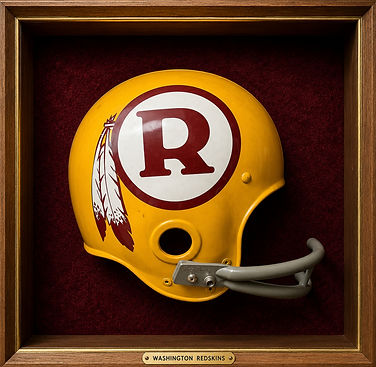
The Washington Redskins' gold helmet with the simple burgundy "R" is one of the most overlooked helmets in NFL history. It didn't have the visual impact of the later Native American profile logo, but that's part of what makes it so interesting. The design was clean, simple, and represented a different era of Washington football—one that often gets lost in the shadow of the championship teams that followed.
Oddly enough, when I see that helmet, I don't immediately think of a player. I think of Vince Lombardi. Most football fans naturally associate Lombardi with Green Bay, but whenever I see the gold Redskins helmet with the "R," my mind goes straight to his brief but important time in Washington. Lombardi only coached the Redskins for one season in 1969, but his impact was immediate. He took a franchise that had struggled for years and gave it something it desperately needed: credibility, discipline, and belief.
There's something about that simple "R" logo that feels like it belongs to Lombardi's football philosophy. No gimmicks. No flash. Just fundamentals, toughness, and winning. The helmet reflects an era when football was a little simpler and coaches like Lombardi were larger than life.
What I love most about this helmet is that it represents a bridge between Washington's early years and the successful teams that would eventually follow. It's not the helmet most fans think of first, which is exactly why I enjoy it. It tells a different story than the more famous Redskins helmets.
For collectors, the gold "R" helmet is a hidden gem. It represents a fascinating chapter in franchise history and reminds us that some of football's greatest influences aren't always tied to the teams we remember them with most. Every time I look at it, I think about Vince Lombardi walking the sidelines, bringing his championship mindset to Washington and laying groundwork that would influence the franchise long after he was gone.
Every helmet tells a story, and the Redskins' gold helmet with the burgundy "R" tells the story of a franchise in transition and a coaching legend whose influence reached far beyond Green Bay. For me, that helmet will always bring to mind Vince Lombardi.
WAshington Redskins
1972-1977

The Washington Redskins' helmet featuring the Native American profile logo is one of the most recognizable and debated helmets in NFL history. Whatever people's opinions about the logo today, there is no denying that for generations of football fans it was instantly associated with some of the toughest, most colorful, and most successful teams of the 1970s and 1980s. The burgundy shell, gold facemask, and iconic logo created a look that stood out every Sunday and became a symbol of winning football in the nation's capital.
When I see that helmet, I immediately think of Joe Theismann directing the offense with confidence and leadership. I think of John Riggins lowering his shoulder and powering through defenders, delivering one of the most famous runs in Super Bowl history. Riggins wasn't just a great player—he was a character, and he perfectly fit the personality of those Redskins teams.
I also think of the Fun Bunch, led by receivers like Art Monk, Gary Clark, and Ricky Sanders, bringing excitement and big plays to an already loaded roster. Their celebrations and swagger helped make Washington one of the most entertaining teams in football.
But more than anything, this helmet makes me think of The Hogs. Names like Russ Grimm, Joe Jacoby, and Jeff Bostic became legendary because they did the hard work that made everything else possible. They dominated the line of scrimmage, protected Theismann, opened holes for Riggins, and became one of the most famous offensive lines in NFL history.
What I love most about this helmet is that it represents an era when Washington football had a larger-than-life personality. From Riggins' toughness to the Fun Bunch's flair to the blue-collar dominance of The Hogs, this team had something for every football fan.
For collectors, this helmet brings back memories of packed crowds at RFK Stadium, championship seasons, and a team that always seemed to have its own unique identity. It represents one of the NFL's great eras and a roster filled with unforgettable characters.
Every helmet tells a story, and Washington's classic burgundy helmet tells the story of Joe Theismann, John Riggins, the Fun Bunch, and The Hogs—a collection of personalities and champions who helped build one of the most memorable teams of the 1980s.